
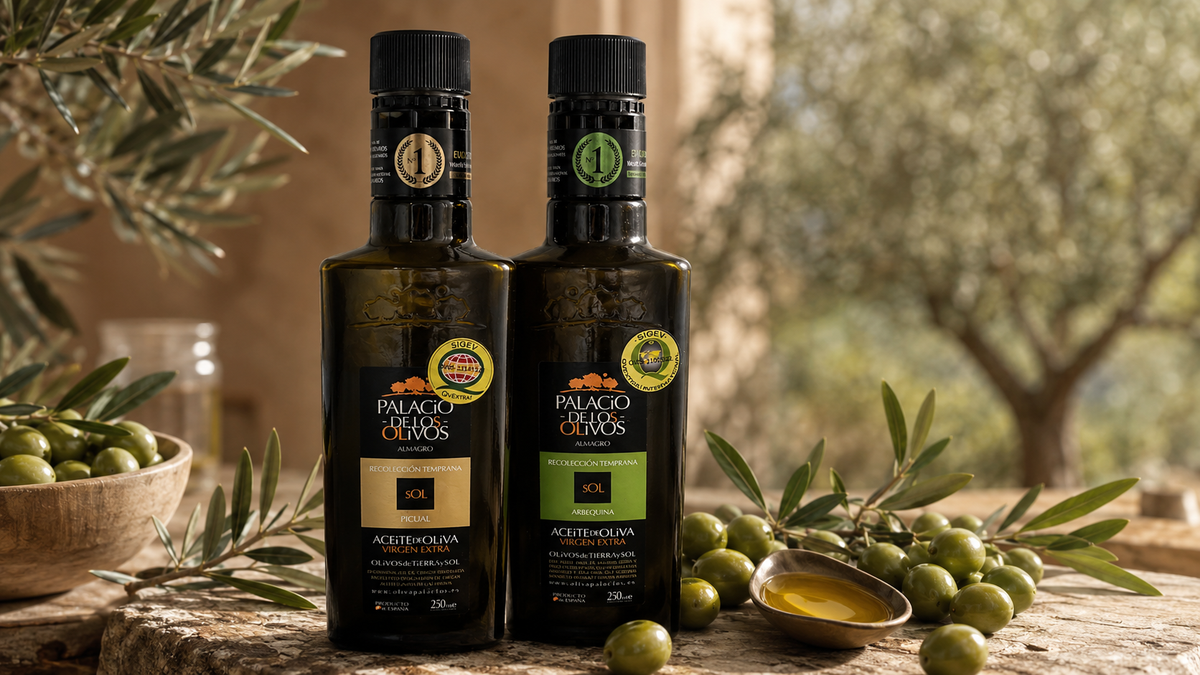
Spanish olive oil in an Italian kitchen? How Picual and Arbequina found their way to Olivo
A product doesn't make it into Olivo's range just because its label is beautiful or its story sounds good. Above all, it has to taste good and earn its place in the kitchen.
That's why these two Spanish olive oils didn't end up at Olivo on a whim.
Anne tested Palacio de los Olivos' Picual and Arbequina all summer long in her own kitchen. Two different olive varieties, two clearly different oils. Over the summer she became so convinced by their flavour that the decision was easy in the end: we wanted these in Olivo's range.
It also raises an interesting question.
Can Spanish olive oil be used in Italian cooking too?
Yes. And sometimes it can be exactly the right choice.
Don't choose olive oil by country alone
Italy is full of excellent olive oils, and local oil naturally has an important place in Italian food culture. If the aim is to cook the food of a particular region as faithfully as possible, the olive variety typical of that region can also be an essential part of the whole.
In an everyday kitchen, however, the question may be a different one:
What kind of oil does this dish need?
The flavour of olive oil is shaped by much more than its country of origin: the olive variety, the growing area, how ripe the olives are at harvest, the time between harvesting and pressing, and how the oil is made and stored.
_________________________________
Just as the grape variety tells you more about a wine than the word “Italian” alone, knowing the olive variety helps you understand what to expect from the bottle.
With Palacio de los Olivos this shows particularly well. Picual and Arbequina come from the same estate and the same producer, yet they taste completely different.
Palacio de los Olivos – the oil begins in the olive grove
Palacio de los Olivos is the olive oil brand of the Spanish family company Olivapalacios. The estate is located in Almagro in the province of Ciudad Real, in the Campo de Calatrava area.
The family's farming background goes back decades, and the project focusing on high-quality extra virgin olive oil was launched in 2009.
The producer grows both Picual and Arbequina olives on its own estate and makes single-variety oils from them in its own mill. The olives are harvested early, green or just as they start to ripen, and taken for processing quickly after harvest.
During production the temperature is kept below 27 degrees, exposure to oxygen is minimised, and the finished oil is filtered and stored in protected steel tanks.
The technique matters, but the reason these bottles are at Olivo is ultimately much simpler:
they taste good.
And above all, they taste different from each other.
Picual – green, herbaceous and peppery
If you like an olive oil that makes itself known in the food, start with Picual.
Palacio de los Olivos' Picual has green tomato, herbs and other fresh green aromas. The taste also has the bitterness typical of Picual and a pepperiness you feel in the back of your throat.
It's exactly these qualities that make it interesting in the kitchen.
Drizzle it, for example, over warm toasted bread and ripe tomatoes. Finish pasta e ceci, pasta e fagioli, minestrone or ribollita with it. Try it with grilled aubergine, peppers and artichokes, or add a little oil over tagliata di manzo just before serving.
Choose Picual when the dish can stand up to a robust oil.
It works especially naturally with tomato, garlic, pulses, grilled vegetables and other deep flavours.
Arbequina – fruitier and softer
Arbequina takes the same idea in a completely different direction.
Palacio de los Olivos describes green apple, banana and herbs in the oil. It's softer and more delicate than Picual, but thanks to the early harvest this Arbequina still has character.
That's why we'd use it when the oil's job is to support the other ingredients rather than take over the whole plate.
Think of ripe tomato, mozzarella and basil. Burrata that needs nothing but olive oil and a little salt. White fish with lemon. A spring risotto. Basil pesto or a simple pasta whose good ingredients don't need covering up.
Arbequina is interesting in focaccia too: it gives the dough olive oil flavour but leaves the grain and toppings to shine.
Choose Arbequina when you want fruitiness and a slightly gentler touch from the oil.
Picual or Arbequina? Choose according to what you're making
There's really no point in thinking of these two as competitors.
If there's bruschetta, tomato, beans, grilled vegetables or meat on the plate and you want the oil to be a clear part of the flavour, choose Picual.
If you're making caprese, burrata, pesto, risotto, white fish or another dish whose more delicate flavours you want to highlight, choose Arbequina.
And for focaccia? It depends on what you want. Arbequina gives a softer result. Picual makes the olive oil itself one of the main flavours.
This may be the most interesting thing about olive oils: there's no single oil that's best in every situation.
____________________________________
What if your kitchen had two olive oils?
It's not a bad idea at all.
In Italy and Spain, olive oil isn't just a neutral fat poured over everything from the same bottle. It's one of the seasonings in the food. That's why you can think of different oils in the same way as different vinegars, cheeses or pasta shapes: their role changes with the dish.
Picual and Arbequina make a particularly good pair precisely because they don't do the same thing.
Picual brings greenness, structure and pepperiness to the food.
Arbequina brings fruitiness and a softer balance.
When you taste both side by side, the difference is easy to understand.
In the end, taste decided
For Olivo, Italian food culture is still the starting point for everything. But that doesn't mean a good product should be judged on its passport alone.
When Anne tried these two oils over the summer, what mattered wasn't that they come from Spain. What mattered was what happened on the plate.
Palacio de los Olivos' Picual and Arbequina were so good and so different that each found its own place in the Italian kitchen too. That's why they found a place at Olivo as well.
Now it's worth doing exactly what Anne did: taste them, use them and notice the difference for yourself.

Leave a comment
This site is protected by hCaptcha and the hCaptcha Privacy Policy and Terms of Service apply.