
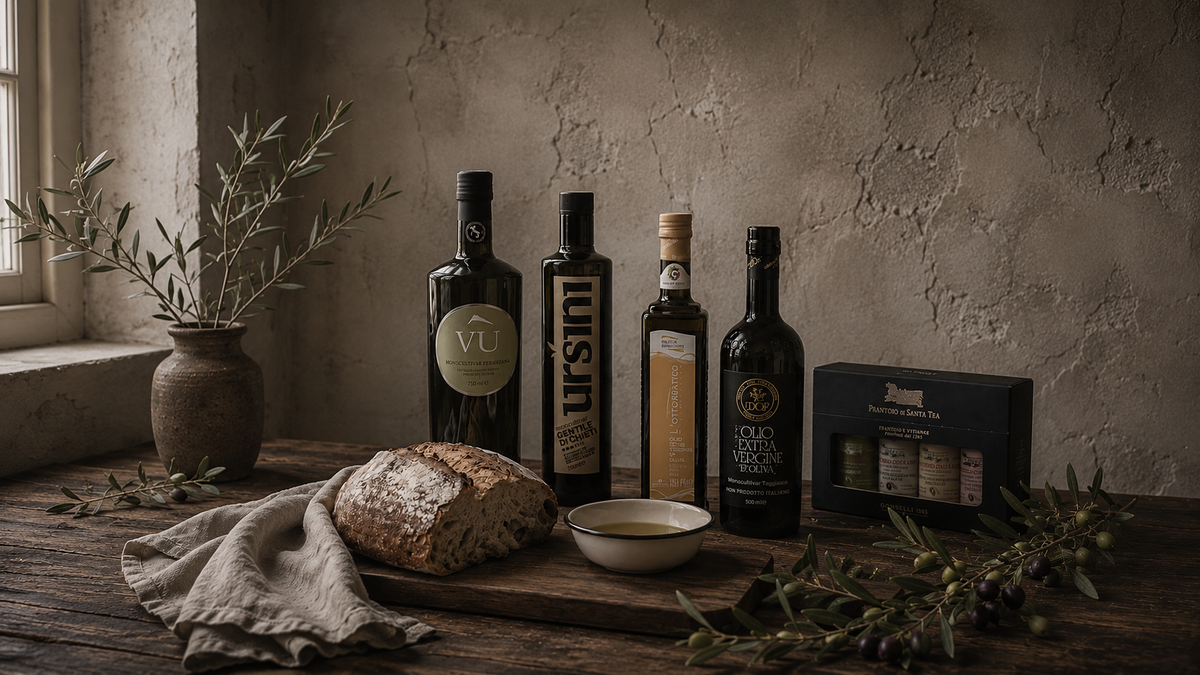
New extra virgin olive oils at Olivo – discover the varieties and tasting sizes.
Olivo's already wide range of extra virgin olive oils has been joined by some interesting newcomers. They include new monovarietal oils, made from a single olive variety, and handy tasting sizes.
Would you like to compare different oils first? The Gonnelli 1585 tasting collection contains four small 20-millilitre bottles: Biologico, Frantoio, Leccino and Moraiolo, whose flavour profiles range from soft and refined to robust and peppery. The collection helps you find your favourite before choosing a larger bottle.

Or perhaps VÚ Peranzana, made in Campania, will catch your interest. Peranzana is an olive variety whose traditional and best-known growing area is in northern Puglia in the province of Foggia, but VÚ's oil is made in Campania. Its flavour is fresh and fruity, soft and balanced, with notes of green apple, fresh herbs and a light hint of almond.

Olive oil has a history spanning thousands of years
The history of olive oil goes back thousands of years. Archaeological finds show that olives were cultivated and olive oil was produced in the Levant as early as around 7,000 years ago. The Levant refers to the eastern Mediterranean, mainly the areas of present-day Israel, Palestine, Lebanon, Syria and Jordan. From there, olive growing and oil production gradually spread to the rest of the Mediterranean.
In ancient Greece, olive oil became an important part of food culture, trade and religious traditions. Besides cooking, it was used for lighting, body care, medicinal purposes and rituals, among other things.
Today Spain is the world's largest producer of olive oil. For the 2025/2026 harvest season, its production is estimated at around 1.4 million tonnes. Italy remains one of the world's most important olive oil countries, and its particular strength is the diversity of its regions, producers and local olive varieties.
What makes Italian olive oil special?
Italy has hundreds of local olive varieties. It's this diversity that makes Italian olive oils so exceptionally varied: one oil may taste green-fruity, grassy and peppery, another soft and almondy, herbal or tomatoey.
The taste of olive oil is influenced by, among other things:
- the olive variety
- the growing area and soil
- the climate and the weather in the harvest year
- the timing of the harvest
- the ripeness of the olives
- the production method
- how quickly the olives are processed after harvest.
The highest quality grade of olive oil is extra virgin olive oil. It is obtained directly from olives using mechanical means only, without chemical refining. The oil must be free of sensory defects and fruity, and its free acidity may be at most 0.8 per cent.
An olive oil for every purpose
In Olivo's olive oil range you'll find extra virgin olive oils for different tastes and uses:
- green-fruity, peppery oils for salads, pulses and grilled vegetables
- soft, refined oils for fish, burrata and light pasta dishes
- full-bodied oils for finishing pasta, risotto, soups and meat dishes
- balanced all-round oils for everyday cooking
- monocultivar oils made from a single olive variety.
There isn't necessarily one olive oil that's perfect for every dish. A milder oil complements delicate ingredients without masking their flavour, while a peppery, intensely fruity oil can stand up to fuller-flavoured food.

What does monocultivar mean?
Monocultivar means an olive oil made entirely from a single olive variety.
When only one variety is used, the characteristics of that olive come through especially clearly. The influence of the growing area, climate and harvest year can also be more noticeable than usual in the taste of the oil.
However, monocultivar doesn't automatically mean that the oil is robust or particularly high in polyphenols. Besides the olive variety, polyphenol content is affected by factors such as the ripeness of the olives, harvest time, production method and storage. Polyphenols are natural compounds in olive oil that affect, among other things, its bitterness, pepperiness and shelf life.

Olivo's monocultivar oils
A single-variety extra virgin olive oil made in Campania. Its flavour is fresh and fruity, soft and balanced, with notes of green apple, fresh herbs and a light hint of almond.
VÚ Peranzana is a good choice when you're looking for a refined oil without strong bitterness. It's especially good with burrata, fish, salads, vegetables, light pasta dishes and enjoyed with good bread.
Ursini Solo Gentile is made entirely from the Gentile di Chieti olive variety. The oil is balanced and fresh and fruity. Its aromas include green grass and apple, and the flavour has both refined sweetness and spice.
Solo Gentile suits salads, vegetables, pasta, risotto, meat and grilled food. It's a good choice when you want a single high-quality, versatile oil for both everyday cooking and finishing dishes.
Olearia San Giorgio L'Ottobratico
Made in Calabria, L'Ottobratico takes its name from the Ottobratica olive variety, whose ideal ripening time is in October.
The oil is at once refined and full-bodied, with notes of fresh grass, artichoke, raw tomato and red fruit. It's especially good with bread, salads, fish and grilled red meat.
The Ottobratica variety was accepted into the Slow Food Presidium programme in 2017. The programme aims to protect local ingredients, growing traditions and production methods.
Made in Liguria, ROI Taggiasca is produced entirely from Taggiasca olives. The variety is known for its soft, delicate flavour profile.
The oil is slightly sweet, fruity and restrained in aroma. It complements food without masking its own flavours, which makes it especially good for vegetables, salads, light pasta dishes, fish and finishing light dishes.
Come and taste
The differences between olive oils are best understood by tasting. You're welcome to visit Olivo's shop to explore the range and find an extra virgin olive oil that suits your taste and your cooking.
You can explore all of Olivo's olive oils in the online shop. The product information includes each oil's flavour profile, usage recommendations and best food pairings.
———————————————————
Sources
The early history of olive growing and olive oil production in the Levant
The study discusses the development of olive cultivation in the southern Levant and archaeological evidence of olive oil production around 7,000 years ago. (PMC)
https://pmc.ncbi.nlm.nih.gov/articles/PMC9996078/
The current geographical definition of the Levant
According to the source, the Levant today usually refers to the area formed by Syria, Lebanon, Jordan, Palestine and Israel. (ORSAM)
https://orsam.org.tr/en/koordinatorlukler/the-levant/
The use of olive oil in antiquity
The source discusses the use of olive oil in ancient Greece and Rome for body care, medicine, purification and religious rituals, among other things. (findanexpert.unimelb.edu.au)
https://findanexpert.unimelb.edu.au/news/134001-healing--purification-and-holiness--how-ancient-greeks--romans-and-early-christians-used-olive-oil
World olive oil production and Spain's position as the largest producer
International Olive Council production forecasts for the 2025/2026 harvest season. (International Olive Council)
https://www.internationaloliveoil.org/olive-sector-statistics-december-2025-and-forecasts/
The number and diversity of Italian olive varieties
According to the International Olive Council, Italy's national collection contains around 600 different olive varieties. (International Olive Council)
https://www.internationaloliveoil.org/the-ioc-announces-the-recognition-of-the-first-italian-olive-germplasm-collection/
The official quality classification of extra virgin olive oil
According to the EU definition, extra virgin olive oil must be fruity and free of sensory defects, and its free acidity may be at most 0.8 per cent. (EUR-Lex)
https://eur-lex.europa.eu/EN/legal-content/summary/olive-oil-analysis.html
The traditional growing area of the Peranzana variety in northern Puglia
According to the source, Peranzana is an Apulian variety grown particularly in the northern part of the province of Foggia. (Azienda Sacco)
https://www.aziendasacco.com/peranzana/?lang=en

Leave a comment
This site is protected by hCaptcha and the hCaptcha Privacy Policy and Terms of Service apply.